

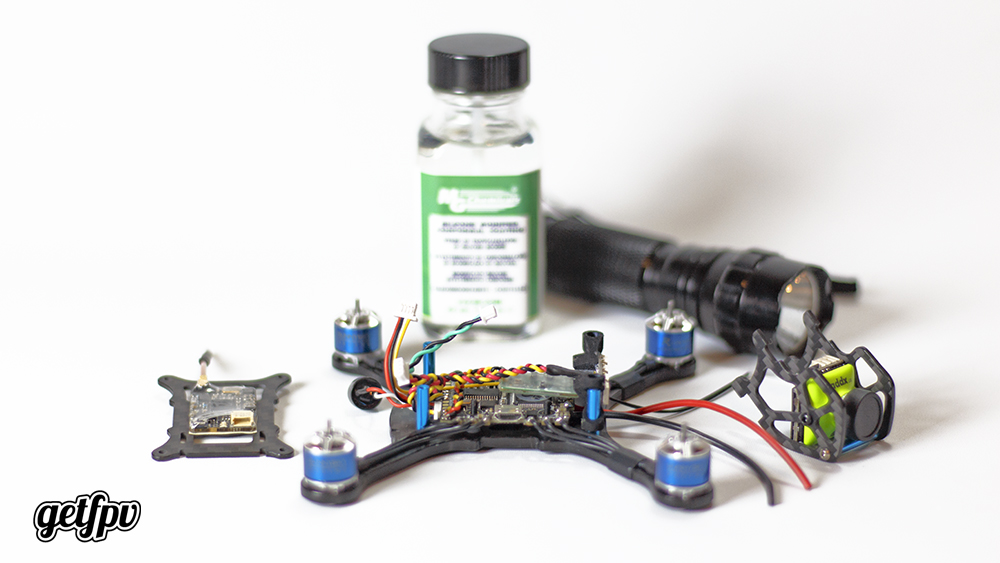
Despite the ruggedness and durability of quadcopters they are full of very sensitive electronics and they are often used in less than forgiving environments. Would you take your home computer half the places you end up putting your quad and still expect it to work? One of the biggest enemies of electronics is moisture, depending on where you live it can be hard to avoid when you are crashing into damp grass or trees, especially in winter. It’s time to waterproof FPV Electronics.[vc_single_image image=”1421″ img_size=”full” alignment=”center” onclick=”link_image”][vc_column_text]The best way to protect your machine is by using silicone conformal coating, this article will step you though the basics of how to conformal coat your electronics so that you can fly with more confidence when there is a chance you might get your quad wet. Of course, it’s not going to make your quad invincible to the effects of rain or snow, but it is more likely that it won’t freak out or kill components when that stray bit of wet grass finds its way into your stack.[/vc_column_text][vc_single_image image=”1423″ img_size=”full” alignment=”center” onclick=”link_image”][vc_column_text]
Tools for the Job
This one’s pretty easy, you need some conformal coating (more detail below). For the best job possible you want some kind of UV torch or one of those invisible ink kids pens with the UV LED on the back, failing that a bright blue LED will sometimes work, and as a last resort bright sunlight actually causes the coating to become more visible.
You will want a clean, well ventilated place to work and some paper towels to catch any stray drips is a smart idea.[/vc_column_text][vc_single_image image=”1424″ img_size=”full” alignment=”center” onclick=”link_image”][vc_column_text]
Conformal Coating Basics
Conformal coating comes in a huge range of products from Aerosols through to 20L drums, for multirotor electronics only a very small amount is needed, and you need to be able to apply it precisely so a small bottle with a brush is the best solution. You will be able to coat a large number of quads with just a small 50ml bottle.
There is more than just one type of conformal coating, the one that you want to look for is ‘Silicone Conformal Coating’. The other commonly available types are acrylic or urethane conformal coating, while they will also work they are not as durable and can not be reworked as easily.
Silicone conformal coatings generally contain Xylene as a solvent, make sure that you use the product in a well ventilated area, it smells nasty and if you breathe in too much of the vapour it can leave you with a wicked headache.
There are many conformal coating manufacturers. I have tried two of them, Electrolube and MG Chemicals. The MG Chemicals product is MUCH nicer to work with, it has a lower viscosity allowing it to be applied more easily, and barely smells. The Electrolube product on the other hand is quite difficult to apply and has a smell that gets into everything![/vc_column_text][vc_single_image image=”1426″ img_size=”full” alignment=”center” onclick=”link_image”][vc_column_text]
What to Coat
When coating your electronics, you need to concentrate on the parts that will be most sensitive to voltage changes. The most important area is the legs of the IC’s on the PCB’s, these legs are often sensing and transmitting extremely small voltage changes and can be disrupted by current carried through water droplets from other connections.
Second most important is the motor esc connections, these deal in larger currents than the on-board IC’s but also ‘listen’ to the very small current sent back from the motor in between firing each phase. If one of the ‘firing’ phases is shorted to the ‘listening’ phase by a water droplet or wet piece of grass it can fry the ESC, or the motor, or both.
It’s counter intuitive, but the main power connections for batteries and ESC’s are not very important to coat. Yes, they deal with the most current, but because of the relatively low voltages and the lack of sensitive transmission water does not affect them as easily. Of course, if you put water between one of these main contacts and a sensitive circuit it will cause trouble so cover as many electrical connections as possible.[/vc_column_text][vc_single_image image=”1427″ img_size=”full” alignment=”center” onclick=”link_image”][vc_column_text]
How to Conformal Coat your Electronics
The best time to conformal coat your electronics is on a fresh build, when everything is soldered together but the quad has not been fully assembled, it is clean and not covered yard goop. You can conformal older builds, but try and clean the parts as well as possible first, a toothbrush and some rubbing alcohol is the best way, but even window cleaner can work, just make sure to allow the parts to dry thoroughly before coating .
I plan ahead when doing a build that I know I will conformal coat and will purposefully only route wires and install parts temporarily, so they can be easily removed to be coated before final assembly.
IMPORTANT NOTE: Do not conformal push buttons or plug sockets, if you get the coating on a button/switch it can wick inside the parts and prevent it working which can ruin the part.
Start with all the peripheral components that can be disconnected with plugs. This usually includes the VTX and Receiver. Remove the heat shrink and paint the coating onto the PCB, concentrating on the legs of the IC’s and making sure to avoid switches and plugs. It is a good idea to paint the soldered connections on the back of plug sockets though.
Once you are done with the peripheral components, you can concentrate on the wired components, including the ESC(s) and FC. You should have most the components wired together on the frame, this allows you to make sure all the wire lengths are correct and tidy, remove the motors and the parts from the frame and you should end up with what I affectionately call a Quadopus.[/vc_column_text][vc_single_image image=”1429″ img_size=”full” alignment=”center” onclick=”link_image”][vc_column_text]If you are building a machine with separate ESC’s then hopefully you remembered to put the heat shrink loose on the wires before soldering them together, push this up out of the way and liberally apply the conformal coating to all the components, paying attention to get it between all the components, especially the capacitors which tend to be tightly packed. Also carefully coat the solder joints for the motors and any exposed motor wire. 4in1 ESC’s are exactly the same process, but you obviously do all of them at the same time.
Coating the FC is pretty much the same process, make sure to get all the IC’s completely covered and be sure to avoid the boot button if your board has one. If not, make sure not to cover the boot pads as conformal coating will prevent you from being able to short these to flash your board.[/vc_column_text][vc_row_inner][vc_column_inner width=”1/2″][vc_single_image image=”1431″ img_size=”full” alignment=”center” onclick=”link_image”][/vc_column_inner][vc_column_inner width=”1/2″][vc_single_image image=”1434″ img_size=”full” alignment=”center” onclick=”link_image”][/vc_column_inner][/vc_row_inner][vc_column_text]Once you have the parts all coated it’s time to get out the UV torch and play CSI detective, the conformal coating contains a UV tracer that fluoresces when exposed to UV light, this is very helpful as it makes it much easier to accurately see where the conformal is and isn’t applied correctly. Simply shine the torch on the parts and check that everywhere glows nice and evenly, again focusing on the IC legs etc. You might be quite amazed at how many spots you missed even when the board looked properly coated to the naked eye. Touch up any spots you have missed and leave the boards to properly cure. With the MG Chemicals product they can usually be handled and installed within 30mins or so. I leave mine on the radiator to cure them faster.[/vc_column_text][vc_single_image image=”1433″ img_size=”full” alignment=”center” onclick=”link_image”][vc_column_text]Now you are done with the conformalling, you can re-cover the peripheral parts and ESC’s with the heat shrink and do the final assembly.
Hopefully this has helped explain how to conformal coat your electronics. You can now pick up the required items and protect your machine, so that next time you try to squeeze in a flight between rain showers or go for a blast over the snow covered landscapes, you can do so with more confidence that if something happens and you go down, your machine won’t freak out or be damaged by the water.
Keep those props spinning, Happy Flying.[/vc_column_text]
Yo that silicone conformal coating the way to go! None of that never wet bs
Where is the best place to buy the coating from ?
I saw a bottle at Fry’s Electronics and later ordered a bottle from Amazon for pretty cheap
Super cool, ha needed this a month ago!
Thanks
this is great info. thank u. i am learning so much here!
Glad we can help! That is exactly why we are doing this, getting into the hobby can be pretty daunting, and the learning curve can be pretty steep, so hopefully we can make it a bit easier and share some knowledge that we have picked up along the way 🙂
Thanks for this. I always wondered how people are getting away with winter/snow flying. I’ve seen a lot of covered with snow pics/videos and was always worried about the electronics.
Excellent write up! I was just thinking about doing this to my quads. Now I’ll have to!
Great info, thanks for taking time to share.
Good information. I once had my 2.5″ end up in a lake. I was able to fish it out after about 5 minutes and as soon as it was out of the water the FC started to boot up. I unplugged as fast as I could then dried everything and it worked perfectly and has flown quite a bit since then.
Great article. It was very informative. Being in the south seems like we always have rain or mud. Need to do this on all my drones. Once I get them flying again of course.
Thanks much for the instructions. Now I can go out and try it for myself.
I coat everything I own, but just hope it covered, do you recommend any small uv light for double checking your work?
I don’t have one that I can recommend personally, I was actually given mine by a friend in exchange for coating some of his parts. I believe they are fairly easy to get hold of either online through Amazon etc, and I’ve even seen them at my local electronics store. Have a bit of a hunt around online and I’m sure you’ll find one near you pretty quickly 🙂
I’m ordering waterproofing now!
I’ve thought about doing this with a quad of mine. I just haven’t gotten around to doing it yet.
What do you do if you need to solder to a joint or pad that has been coated? are the fumes toxic?
You can actually solder right through it with no issues. It tends to go a little gummy around the solder joint and you will need to clean your iron tip a bit more often but other than that, there’s really no difference to normal soldering. I do tend to scrape as much off with a scalpel blade or similar if I can, prior to resoldering but that’s just to avoid getting my iron dirty. As for the toxicity of the fumes, I’m not sure, I read the datasheet for the conformal itself and it doesn’t seem to have any significant risks, but doesn’t discuss burning the product. I cannot imagine that the fumes from soldering through would be any worse than the normal smoke from the solder, but adequate ventilation is always a good idea when soldering.
Do many companies coat their board from the factory? I noticed when soldering my holybro esc’s and fc, that there seemed to be a coating covering the pads that I had to burn through before I could get a decent solder joint.
Thank you for the information, I was about to tear down a build and do this, but I will wait for a uv lamp first!
Good idea! The UV lamp really makes the whole process much easier and you can be more confident your parts are properly protected.
I keep meaning to do this! Great write up, will refer back to this when I start the process.
Glad we can help!
This is exactly what I need! Idaho is not quad friendly, at least not until oh say July! Thanks you guys/gals!
You’re welcome, having your quad protected certainly inspires a bit more confidence when the conditions are a bit sketchy
Thanks for the article it was a good read
You’re welcome!
I have a can of aerosol con-formal coating, also from MG chemicals. (Its acrylic)
it works great! goes on thick, dries fast, doesnt stink too much either. the only issue with it is that it requires a lot of masking to keep it out of the buttons and plugs.
And as a result, I almost NEVER use it.
as such, the brush on type of coating is more practical for our type of use.
Hey Blair, what frame and FC is that you are working with? I’ve been meaning to get a brushless micro.
If there was a quicker way to use the aerosol sprays that would be awesome but the brush on is definitely the best way at the moment.
That frame is actually one of my own designs known as the ‘Nemesis X’ and the FC is the HGLRC Zeus all in one FC/ESC. It’s an excellent little bit of kit, albeit a little on the pricey side, but allows for super clean builds and takes up hardly any space. This was a BNF that I was working on for a customer and just luckily had it sitting there when it came time to write the article.
Definitely get yourself a micro! With the advances in cameras, FC’s, and motors in the recent months, they are now amazing to fly and have a lot of advantages and very few drawbacks when compared with larger quads. 2.5″ would be my recommended size (Not just because that’s the size of my design, but that is why my design is 2.5″) the power to weight and disc loading is almost perfectly in scale with traditional 5″ quads and therefore the flying experience is similar.
There’s a great Brushless Micros group on facebook which will let you see all the different options and what people recommend: https://www.facebook.com/groups/brushlessmicros/
Once I started putting conformal coating on my builds I never went back! I see it as extra layer of protection to your drone and overtime you save money.
really cool !
i have heard of a product that is great for the motor if we go over salt water,
it’s nammed corrosion X hd
Make sure you take your sweet time with application of silcone conformal coating or it will chip and crack away leaving the equipment at risk !!! Happy Flying !!!!!!!!!!!!!!!!!!!!!!!!!!!!!!!!!!!!!! ^_-
Super cool stuff! And great writeup
Thanks for the info. Didnt know there were different types of conformal coating products
Thanks for the guide.
Thank you for this great article. I just ordered some of the MG Chemicals modified silicone conformal coating. This just seems like cheap insurance to me.
Great guide, I’m going to have to coat mine very soon. I landed in just the tiniest amount of snow the other day and my drone stopped working for a little bit. Nothing was damaged luckily and I had to wait a couple hours for the water to dry off but I was out of the air for a while. Now I won’t have to worry if I do this!!
Thanks!
A build is never complete until an application of silicon conformal coating is applied. I could not proceed forward without that extra sense of security. A 55ml bottle goes a long way and worth every penny. My only 2 cents Ill leave here is do yourself a favor and have some sort of ventilation, as this compound is as beautiful as it is pungent and noxious.
Cool, one less thing to worry about.
Really helpful post, since I live in a place where winter is one rainy day after the other!
I appreciate the info. The UV inspection is more important than I thought. Thanks!
These instructions have been really helpful to me, thank you getfpv for the guide!! Have used this for reference a few times now
thank you. i actually learned alot from this article and will have to revisit it soon.
Great instruction, very helpful. Thanks
Great info. I definitely need to look into this because I mainly fly in FL and GA and the 100% humidity and the dew in the mornings sometimes leaves moisture on my gear. Thanks!
Went through the comments and didn’t see this being asked, so it might just be a n00b question: what about the motors? (Both brushed and brushless)
And a bonus question: what about components that heat up, such as the VTX? Will they not melt the coating / overheat because of it?
Thank you for the article – I’m doing mine now, with all the rain going on outside 🙂
Good Questions! The motors are naturally waterproof/resistant because the wires are enameled to stop them shorting out against eachother so dont put any conformal in there because it will definitely gum up your bearings!!!
Silicone conformal coating is specifically designed for components that are exposed to heat, it will stay perfectly functional well past the max temperature the VTX can handle. Do be careful though, it can cause the VTX to get a bit hotter as it creates another layer on the VTX. I’ve always done mine and then put the heatshrink back on and have never had a problem, so you should be all good. Pro tip try get as much of the VTX surface in contact with carbon (the heatshrink, not the pcb itself, you dont want it to short out!) The carbon acts as a heatsink and will keep the vtx much cooler than if it is just sitting in an open space 😃
Cheers
Blair
Thank you for the explanations, Blair!
I wasn’t thinking of getting conformal coating in the motors, but wasn’t aware of their internal coating.
Here’s a bonus question: for tiny whoops, the motors are connected via JST 1.25 connectors on the board, and they are exactly on the side that would most likely land in a puddle / wet grass – is there a way to waterproof those as well? Maybe paint the connector on the outside, after plugging it in? (Would it seep in?)
And great tip for the VTX, makes sense 🙂 (I was actually thinking of using a tiny copper plate, stuck with thermal adhesive on it)
I have started keeping the MG422B bottle in a ziplock bag when I am not using it, so it doesnt go all gummy and the lid doesnt get stuck anymore.
Hope GetFPV would sell the Conformal Coating, has shopped several times and looked for it all over and never found it.
I conformal coated my flight controller, 4 in1 ESC and VTX and now my quad doesn’t turn on. I get a green light on the FC, but no tones. Has anybody had this happen to them and how doi fix it?
How long has it been since you applied the conformal coating? It’s usually a good idea to wait ~24 hours before powering anything.
Very good advice! I’ve been using Silicone Conformal Coating for some time now and it’s saved me a ton of time, money, and trouble.
Can i coat for example a inside parts of smartphones? I want to coat a iphone 6 motherboard for cases if it be dropped in water to don’t damage the motherboard? Is it safe to use it on smartphone inside parts?
Great article!
now, how do we identify the barometer chip, so we can avoid covering it ?
The barometer is easy to identify. It’s the 2mmx2mm metal “chip” with a tiny hole in it (sometimes 2 and rarely even three) It’s the one part you DONT want to coat with anything (you don’t want to stop up those little holes)
My question is how do you waterproof the barometer?
And BTW: CorrosionX brushed onto switches and plugs (any removable connection) after applying the conformal coating to the rest of the boards, will waterproof them as well.
New to the hobby and trying to understand what and where I should use the MG Silicon Conformal on. I have a TinyHawk II. He said to coat the ESCs but although hearing the letters I have no frame of reference for what this means and where it is on the TH2. He also says to do the ICs on the PCBs, from computer work I assume he means the chips on the board.
Any advice to coat a RTF type device like the TinyHawk II where you aren’t doing a “build” and it is already assembled?
Bonus tips if you can tell me (tell me where they are, too) the areas to avoid on this quad? I can guess motors, bind button, and the micro usb port, other then that, not really sure. Especially not sure where the barometer is.
Also I bought a 5 LED 365nm UV light. Is the light only to shine to see things are coated, or does it actually cure? Do I need to shine the light at the curing coat for 30 min? Or is it only to spot check and then you put it in the sun? (don’t have a radiator).
Thank you
Why not coat the components before assembling them? Provided you work around the plugs and switches.
Can a quad with DJI unit be conformal coated?