

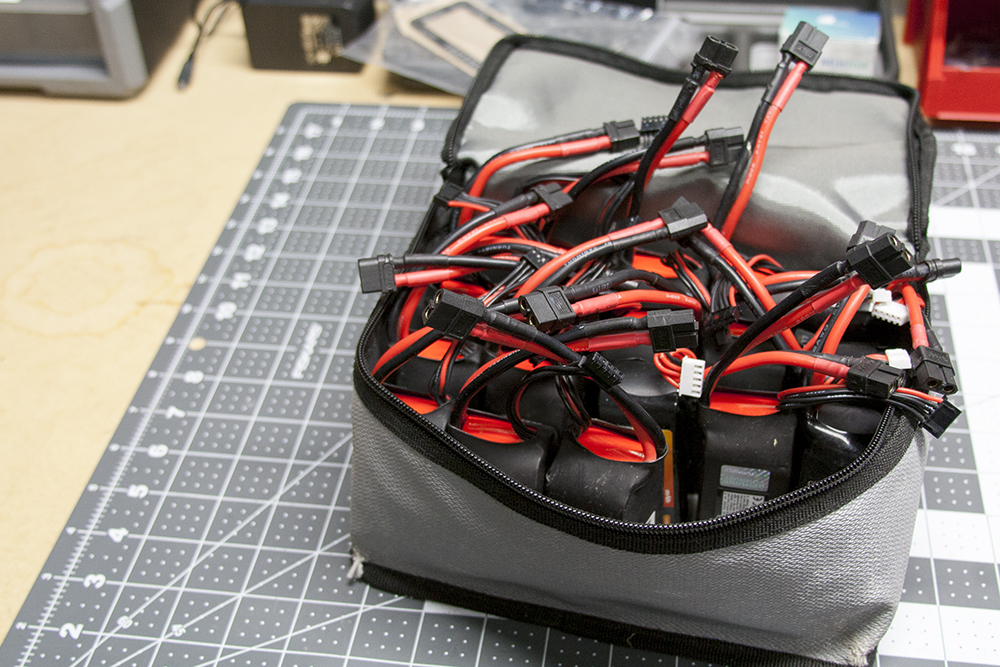
Investing in batteries for your multirotor can be an expensive proposition, and one that can be ruined by not properly caring for them. Lithium polymer batteries are some of the most powerful batteries available but are also some of the most sensitive. They definitely have a finite life span, making them one of the consumable components in the hobby. Following proper FPV battery maintenance, you can make your investment last, and keep your batteries performing at their maximum.
If you are new to FPV, and are looking for more great information on batteries, refer to our All About Multirotor Drone Batteries article for more great information![vc_row][vc_column][vc_single_image image=”1594″ img_size=”full” alignment=”center” onclick=”link_image”][/vc_column][vc_row][/vc_row][vc_column][vc_column_text]
Structure of a Lithium Polymer Battery
Lithium polymer (LiPo) batteries are a great choice for model aircraft for a few different reasons. Based on their chemical makeup, they are among the most powerful batteries by weight that exist. They are particularly energy dense, and have the capacity for delivery that power extremely quickly on demand. LiPo batteries use a few different components to create a charge that you can use. Understanding that structure is key to understanding how to properly perform FPV battery maintenance.
LiPo batteries use a series of alternating structures that facilitate the transition of electrons from one layer to the next. These layers, the cathode and anode create a pathway for charge to flow. The cathodes use aluminum and is coated in an oxidizing lithium material. The anodes use a copper material along with a carbon material, such as graphite. The anodes and cathodes alternate between a micro porous polymer membrane, the separator. The entire structure is suspended in a lithium gel electrolyte. Lithium itself is highly reactive to both air and water, and when the battery has a puncture or cut, can cause a fire.
When a battery is charged, the cathode passes lithium ions through the electrolyte and separator, to the anode, where they are stored for use. This gives your battery it’s “charge”. When discharging, the process is reversed; the anode passes the lithium ions back to the cathode, and that charge is pumped into your model for use by your electronics.[/vc_column_text][/vc_column][vc_row][vc_column][vc_column_text]
Internal Resistance
One of the primary indicators of battery heath is going to be the internal resistance of the battery. Generally measured in term of milliohms (mΩ), the internal resistance of a battery determines how hard it is to pass the energy stored in the battery to the model aircraft. The higher the internal resistance, the harder it is to pass that energy.
During use of the battery, there are many things that can cause internal resistance to rise. When you deep discharge your battery (take it below the 80% discharge level), that can cause internal resistance to rise. Also, when pushing the battery to pump out maximum energy over an extended period of time, can affect internal resistance negatively. Batteries over time will naturally build up internal resistance. Lastly, excessive heat can also adversely affect internal resistance. When internal resistance becomes too high, there comes a point where the battery will stop delivering all the potential energy that it was originally capable of. At this point, you may need to remove the battery from service.
When selecting a charger, you may want to look for one that can measure internal resistance. In this way, you can be up to date on the health of your batteries. If your charger does not monitor internal resistance, there are devices out there, called ESR meters that you can use.
Internal resistance is one the primary concerns when we are discussing FPV battery maintenance. When you don’t take the time and care with your batteries, their life span, and your investment, will be cut short. Believe me, I have experienced this firsthand.[/vc_column_text][/vc_column][/vc_row][vc_row][vc_column][vc_single_image image=”1604″ img_size=”full” alignment=”center” onclick=”link_image”][/vc_column][/vc_row][vc_row][vc_column][vc_column_text]
Proper Charging
Proper charging protocols are the beginning of excellent FPV battery maintenance. When charging your batteries you want to take a few things into consideration. First, would be the capacity of your battery. Capacity is defined by how much charge your battery can both store, and deliver, and is rated in amp hours, or Ah. Because of the size of our batteries, that is often reduced to milliamp hours, or mAh. One of the most common capacities in use for multirotors would be the 1300 mAh battery, and as such will be the one that we will be using for our example.
What Amp Setting to Use?
When determining the proper amperage to charge a battery, one will directly reference the capacity. You will often here pilots talk about what “C” they charge their batteries at. You can determine “C” rating in amps by using the following equation; cA = mAh / 1000. In the example of our 1300 mAh battery, this equates to 1.3 amps. So now, when someone talks about charging their 1300 mAh battery at 2C, you can calculate that out to be 2.6 amps, using this equation; 2(cA) = (1300 mAh / 1000).
Most batteries will alert you to the maximum rate that you can safely charge your batteries at, either on the battery, or with the included documentation. For example, the Lumenier Batteries are rated at a maximum of 5C charge rate. Now, the question is, does that mean that you should always charge your battery at this rate? Absolutely not! Charging a battery at that rate will accelerate the decay of the battery, and raise your internal resistance quicker. Charging batteries is similar to creating good barbeque; low and slow. The recommended charge rate for any battery is going to be 1C. Charging at 2C should be the highest you go, and only if you are in a hurry.
Don’t Walk Away!
On a safety note, never leave your charging batteries unattended. The hobby is rife with examples of LiPo fires taking out a pilots gear, garage, or entire home. Even with someone paying attention, these things can happen, but by being around your batteries when charging, you can react to a situation much quicker. Proper FPV battery maintenance always starts with good safety practices.[/vc_column_text][/vc_column][/vc_row][vc_row][vc_column width=”1/6″][/vc_column][vc_column width=”2/3″][vc_single_image image=”1597″ img_size=”full” alignment=”center” onclick=”link_image”][/vc_column][vc_column width=”1/6″][/vc_column][/vc_row][vc_row][vc_column][vc_column_text]
Parallel Charging
Parallel charging can be a way to get several batteries charging at once, but use with caution. The way parallel charging works is by using a charging board specially designed to accomplish this task. When several batteries are hooked up to the board, the charger sees them as one large battery. In order to charge these batteries at the same rate as you would a single battery, you need to do a little more math. In our example, we are going to use the 1300 mAh battery again, and we are going to charge six of them together using a parallel board. Using this equation, we can determine what 1C is; cA=6(1300 mAh / 1000). From this equation, we get 7.8 amps. Now if we wanted to charge at 2C, it would look like this 2(cA) = 6(1300 mAh / 1000), resulting in 15.6 amps.
The Do’s and Don’ts of Parallel Charging
There are three things to consider about parallel charging when considering proper FPV battery maintenance. Firstly, never charge batteries that have a different number of cells together. For example, do not charge 3S batteries with 4S batteries. Doing so will damage your batteries, might damage your charger, and may start a LiPo fire, which we should avoid.
Secondly, batteries that are to charge together need to have very similar voltages. Optimally, they need to be within .10 volts from each other. If they are not, you may need to “bump” charge them to get them within that range. Not heeding this advice can lead to batteries with a higher charge dumping that charge into the lower charged batteries and a very fast rate, damaging both.
Lastly, and most important, internal resistance rears its ugly head here. Think of internal resistance as a virus that infects your batteries. That virus can “transmit” to your other batteries through the parallel charging process. So if you have a bad battery, and you charge it together with other batteries, you can corrupt all the other batteries.
I’m not going to tell you not to parallel charge, but ultimately if you want to make sure you don’t corrupt your batteries, or don’t want to have worry about matching voltages, you may want to look into a multiport charger. It’s truly the safest option out there.[/vc_column_text][/vc_column][/vc_row][vc_row][vc_column][vc_column_text]
Discharging Batteries
Alright, so we have our batteries charged, now we get to go out and rip with abandon right? Not so fast there, Sparky! Discharging your batteries through the use of them on your model is where the most damage to your battery can, and will, occur, and is the place where we absolutely must practice proper FPV battery maintenance.
First off, never discharge your batteries completely. This will cause your batteries to heat up to levels that are out of specifications for the battery. Remember, excessive heat builds up internal resistance. The maximum that a battery should discharge to is 80% of the total capacity. So in the case of our 1300 mAh battery, that equates to 1040 mAh drawn out. Additionally, never discharge any individual cell below 3.0 volts. In a 4S battery, using this standard, overall voltage should not come to a resting state below 12 volts (3 volts X 4 cells). Personally, I don’t draw down my 4S batteries below 13.8 volts.
Another cause of battery damage is drawing the battery down too quickly with long duration high throttle. Doing so will over tax the battery, again leading to high heat generation. Keep your boosts of throttle relatively short, optimally less than ten seconds in duration.[/vc_column_text][/vc_column][/vc_row][vc_row][vc_column width=”1/6″][/vc_column][vc_column width=”2/3″][vc_single_image image=”1596″ img_size=”full” alignment=”center” onclick=”link_image”][/vc_column][vc_column width=”1/6″][/vc_column][/vc_row][vc_row][vc_column][vc_column_text]
Choosing the Right Battery
When it comes to discharging batteries through use in your model, you want to select one that will provide the appropriate amount of power. Selecting a battery that does not have the capability to discharge the power needed by your motors, will cause your model to be slow and not perform as expected. It will also overtax the battery, thus damaging it. Printed on the battery you will usually see two numbers; the lower number is the constant “C” rating, telling you how much power the battery will be able to deliver relatively consistently over the discharge cycle. The second number will give you the burst “C” rating, which is the amount of power the battery is capable of pushing out for short burst, usually up to ten seconds.
Calculating Battery “C” Rate
Batteries are rated for their discharge rate using the same equation that we used for the charge rate, and using that equation, you can select the appropriate battery for you model setup. Let’s take a quick look at the Lumenier 1300mAh 4s 75c Lipo Battery. This particular battery is rated at 75C continuous, and 150C burst. When we apply our equation, you get some true numbers in terms of amp draw that you can relate to your model, and we will calculate that out below.
C(mAh / 1000) = Amps Capability
So in the case of our 75C/150C battery, that looks like this:
75(1300 / 1000) = 97.5 Amps Continuous
150(1300 / 1000) = 195 Amps Burst
That’s a lot of power available for your motors to use, and would be a good option for a moderately high power build. However, let’s look at a lower “C” rated battery, such as a 40C / 80C battery.
40(1300 / 1000) = 52 Amps Continuous
80(1300 / 1000) = 104 Amps Burst
Now this battery would not be good to use on that same high power build. The motors might draw more than 52 Amps just at a medium high throttle, and there are chances that you would damage the battery. Does this mean that you should always go for high “C” rated batteries? No, not at all. In fact, what it does mean, is that if you have a model that does not require a higher “C” rated battery, that you could select one that will work for your build, and potentially save some money. Higher “C” rated batteries are usually much more expensive than one that is lower. Selecting the right LiPo for the job is another way to exercise proper FPV battery maintenance.[/vc_column_text][/vc_column][/vc_row][vc_row][vc_column][vc_column_text]
Storage of Batteries
The last thing we are going to cover for proper FPV battery maintenance is the correct storage of your batteries. When you get home from the field, one of the first things you should do is to set all your batteries to storage charge. This will put them at the nominal charge for being put away on the shelf, and ensure that they are ready for the next flight session. This also puts the battery in a stable state, in which the likelihood for damage and build-up of internal resistance is much less.
If you have fully charged batteries that you aren’t going to use relatively quickly, such as the next day or so, then go ahead and discharge those to storage charge as well. Leaving a fully charged battery to sit for longer periods of time will cause some damage. Nominally, the voltage for should be around 3.8 volts per cell to be at storage.
This also gives you a chance to inspect each of your batteries for any damage after your flight session. You want to look for issues such as cut cables, damaged connectors, holes and punctures, and dents or bends in the individual cells. Any kind of damage needs to be assessed for both safety and viability of the battery, and a decision needs to be made if the battery can be still be put back into service after repairs.
FPV Battery Maintenance keeps your Investment Healthy
Batteries are expensive, and without them, you aren’t going to be flying much. Taking the time and effort into proper FPV battery maintenance will protect that investment, and keep you in the air. It also means that you won’t need to replace bad batteries as often, saving you money for all the other things you want, like new models! These practices will also keep you, your family, and your things safe. Remember, LiPo’s can be volatile when not properly cared for![/vc_column_text][/vc_column][/vc_row]
great article. Thank You!
Some important points, thx
Great article! A must read especially for beginners.
Very informative and insightful. Thank you Josh.
This is a great introduction and set of guidelines for using LIPOs. Unfortunately, very few people learn about these things when they’re on their own getting into the hobby.
Helpful!
Wow this is so helpful! Thanks for this info!
Great summary! I’ve been using LiPo batteries for years and learned something new … a battery that has a high internal resistance can “infect” others if parallel charged with “good” batteries. Interesting and something I will look out for.
I have been flying for about 3 years and it’s for sure a dream come true! Never thought I would be able to do anything so unbelievable! Every time I show a new person their minds are blown too! Thank you GetFPV for making this hobby possible for people like me! If you have never tried this hobby and put the goggles on for the first time your mind will be amazed!!!!!!
Good and useful info
Excellent article on Lipo batteries and their care.
It’s so tempting to try and squeeze another minute of flight out of a Lipo. But it’s just not worth over discharging your battery. I’ve paid the price for this and damaged batteries. I try not to go lower than 3.5 volts a cell nowadays. Much lower than that and your quad will probably failsafe on you anyway.
There is a trick that i have used many times to save over discharged batteries, simply charge them on your chargers NIMH setting at 0.1 amps (which will be below 0.1c) until they get to around 3.2 volts a cell then charge them like normal. Obviously there are risks involved with this and although i have never had a lipo fire i like to charge these over discharged batteries in a secure place ( i put them outside in an oven tray just to be safe!)
This is a good article about lipo batterry care, especially about the parallel charging and storage, thanks for so detailed information
Awesome article! Batteries make me nervous sometimes because of all the horror stories, especially about parallel charging, but the article helped me understand them better so I’m not nearly as nervous now.
This is a great article! I’ve been looking for something to read that covers everything to know about LiPo batteries, and this is just the thing.
Never heard the claim that internal resistance can spread through parallel charging Li-Pos. What is this based on? Sure charging a damaged battery with high internal resistance is never good and probably worse when parallel charging it, but parallel charging batteries with diffent resistances shouldn’t affect the other batteries?
Greetings!
I just received your email this morning and was drawn to the excellent article by Josh Cook on LiPo battery care and usage. I was hoping I can use this article to share with our clients. Of course we would recognize getfpv.com and Josh for the excellent work.
We spend a considerable amount of time with our AgEagle clients on the importance of LiPo management and we want to reinforce the importance by posting the article on our social media. My only concern is our clients may not understand the difference between flying a fixed wing still image gathering agricultural drone and an FPV system, so could I have permission to change the reference in the article of “FPV batteries” to “LiPo batteries”?
Again, it was an excellent, well written article that needs to have more attention.
Thank you!
Tom, feel free to share the article with your clients via social media. In fact, there are buttons right at the bottom of the article for you do just that! However, I do humbly request that you do not change any references in the article. However, when you do share the article, you could put comments on the post relating it to the use of LiPo batteries that your clients could understand. If they have any questions, I am happy to be a point of reference for them. Also, if you have time, I’d like to discuss the great way that you are using RC models to aid in agriculture. Great stuff, and would love to learn more!
Excellent article! It covers a lot and for someone new to the hobby, it might be a lot to take in. Read it over and over until you are comfortable with it. One thing I’d like to advise is that you do not throw your “bad” LiPo’s in the trash. Find a way to completely discharge them (safely) and/or dispose of them at your local recycling center.
Great primer on batteries! Concise and well-written. Thanks, Josh!
Great info, hope I have better life out of my batteries now.
Thanks for the info Josh.
It’s a very important topic.
Great article, if only I followed all these recommendations with my batteries they might last longer.
Thanks for the article, I’m still sort of new to the fpv community. Quick question, what’s the average life cycle of a LiPo battery assuming the batteries are properly cared for? I’ve read it’s approximately 300-500 cycles, but is that dependent on size?
Not so much dependent on size as use and care. Also certain batteries have different chemistry that sometimes lead to greater life cycles. Low “C” rated batteries also tend to last longer when applied correctly when compared to higher “C” rated batteries. Less stress = longer life span.
Commenting to say that this article is very useful, and also to be entered into the 100 dollar gift card draw!!!
Good article. Would like to see different ideas how to discharge batteries. One thing I’ve done is use then to charge other batteries, like my Tiny Whoop batteries & Goggle batteries which tend to get a lot of use. I’ve also charged household rechargeable (AA, AAA, etc) batteries.
There is a lot to be said about a plain o’l battery, the lipo battery commonly used for multirotors can be a blast ( literally ) and I’m glad to see your in depth article on the matter, I’ve been flying for years and I still found it interesting and can say I learned more about them and how to get the most out of them ! Hats off to the crew at GetFPV for helping us out! Keep it coming guys, love the content as well as all the awesome products. And I can’t not leave a note about the shipping, simply the fastest shipping I’ve experienced to date ! You guys are killing it !!! C-ya
Great info on Lipos
I went to a race recently and the other guys were charging as high as 4c. Was shocked!
I have always wondered what the best practices were for battery usage was. This helps greatly and answers a lot of questions I have had in the past.
Thank you
Thank you Josh for sharing your knowledge of Lipo battery maintenance. I didn’t know that internal resistance made such a difference. I also liked your point of selecting a battery based on the type of aircraft build. A good point to stress would be battery disposal at the end of it’s life.
Thanks for the feedback! I will update the article shortly with information on how to dispose of old Lipos.
Definitely a good read, I always charge at 1C never more, don’t wanna burn anything down.
Thanks for the great info..
Very useful safety information on parallel charging. Highly applicable as most people have multiple packs to charge these days.
OK this is a article all using lithium batteries should read.. I have had some real bad experiences with leaving batteries unattended almost burned down shop (18,000 in damage) and a garage due to cheap charger malfunctions. Lesson dont leave unattended and dont put 30 lipos on a shelf inside together. I charge now in a 1/8th 2ftX2ft square.. Thanks for putting this out..
Yikes! Sorry to hear about your bad experiences, hopefully this will help keep that from happening again! Keep safe!
Good article and information. Anyone who looking to get into the hobby who hasn’t dealt with LiPos should read it.
Great information! Thanks!
This has been one of my favorite articles to reference about parallel charging. It is written in a way that anyone can comprehend how you should be charging your batteries. And its always nice, when you’re questioning your inner math abilities, to have a go to place to double check your thinking!
Always happy to help Travis! Glad you found it informative!
Is there an automated way to discharge your batteries for storage, other than flying down to a set voltage? I’m only flying 1S micros right now, and none of them have OSD.
Several chargers on the market offer a discharge function that will bring your batteries back to storage charge.
Very good information had no idea that resistance could infect other cells in parallel charging.
Thank you for the in depth write up. even though I’ve been flying for a while, it’s still nice to have something to reference and something you can double check! Thanks Getfpv!
Great information
I have been flying FPV since 2009 and have been parallel charging lipos almost as long. You are correct that lipo charging can be a dicey [ if not downright dangerous] situation if not done correctly. I always charge mine at no greater than 1C. Additionally I use ammo cans to store my batteries at the 80% storage capacity programmed via a smart charger. I have lipos that are over 6 years old and they are still working good. Never leave them alone when charging, use a ceramic bowl and have a fire extinguisher nearby.
Very informative article. I love my LiPo’s but they really need to be cheaper.
Thx
Hey Thanks for the great article!
I’ve got a pile of dead batteries, but don’t know what to do with them. Where in the heck can I get these things recycled?
Very informative! Everyone should know battery safety before charging and using with lipos.
Am I the only one who would leave batteries charged after a day of flying? lol thanks for the tips!
Yes this I very help but can you leave a half charged batt for storage
Great information, but I think you might want to rename the title. There was just too much information for “Maintenance and Care”. You talked a lot about information on the Lithium Polymer structure, I feel way too much just for Maintenance and care.
Lots of great information
Thanks
Great all-in-one place for quality information.
Nice article, everyone should take the time and read it. Thank you.
My bag looks like that cover photo haha
Great article. I appreciate the numbers on this page being specific … I was always wondering what voltage the battery should be at storage. Thanks GetFPV!
I’m new to drone racing and free style, the battery charging info is just what I needed.
I would also like to add that the temperature of the lipo before charging or putting back on the charge after use should be included. If you store your batteries outside in very low temps (below 32 ish), then you should bring them inside to get to a decent temp before charging. Also, allow your batteries to cool down before recharging. I get several hundred charges or more off my lipos following all of the guidelines descibed in this article.
This is really great advice. Letting your batteries rest after flight before throwing them back on the charger will keep them healthy. Thanks Steve!
This is a great consolidation of info. I feel like battery usage/maintenance is one of the most challenging (and scariest) aspects of the hobby when you’re new.
Great in-depth look. Charging batteries is like a BBQ, but don’t let it bring the heat. Watch those chargers!
How do I safely dispose of a bad lipo?
I will be updating the article to reference this! Great question!
Awesome info! Battery maintenance and proper usage of LiPo batteries is one of the first things I try and tell people to research when I’m getting friends into the hobby! Once you understand their proper charging and flight usage and make it a habit, it’s really no big deal! Charge, fly, and store properly… then repeat!
Definitely one of the more important aspects of our hobby! Glad you’re pushing this with your friends!
Really appreciate the great information. I’m interested in how you choose a battery for a long range fpv rig swinging 6″ props on 2206 1800kv motors?
Thank you for this informative article! I think Lipo charging and care can be a bit intimidating for new pilots, but this guide does a good job of teaching the right calculations and safety precautions.
I read this to keep my house from exploding. Now I feel like my head is going to explode with all the new knowledge. 😉
Great article! As a relatively new pilot, this helps a ton. Thanks getfpv.
Nice article, especially the part talking about parallel charging.
Please keep sharing this kind of useful information.
Will do! Happy to help!
Nice! Maybe I can stop blowing up batteries by reading this!
Thanks, useful info. I typically don’t parallel charge although I have parallel boards in case I’m running dual batteries in the same aircraft and they happen to discharge fairly evenly with each other.
That’s pretty noice
I’m afraid to discharge with my ISDT charger, the fan is melted, so I’m debating getting the big discharger.
A nice article, there are a lot of interesting things
I have had many friends in this hobby have lipo fires during charging. Luckily the only damage has been to there lipos and chargers.
Take extra precaution. Equipment can fail and fires can happen even when you are doing everything properly.
great article. Thank You!
Great Post simple and to the point. A good how to for battery care. appreciate you taken the time to write.
Thank you
Great article. I didn’t realize that 1C charging mean one * the capacity. I thought one C mean 1amp…so I’m glad I learned that before burning my house down. Lol.
This is a lot of great advice i wish i knew earlier on, good for all the new people in the sport.
Good article
This article was very helpful. Is there an online calculator or an app that would calculate charging rates and other things like that?
Lane, using the formulas in the article is truly all you need. I keep a list of charging voltages for quick reference for my batteries to make sure that I am applying the right amount of amps. Easy to post up next to your charging station to glance at as you a prepping.
great insite, as I’m new to the hobby and want to get the most from my investment, thanks
I would like to have had this information a few years ago to avoid learning the hard way – Great summary.
Thank you for this article. I’ve been flying for about two years, and I just experienced a lipo fire in my apartment. Thankfully I was sitting across the room, and smelled it just before it burst into flames. I was extremely lucky. A fire extinguisher was just installed in my apartment just two weeks prior. Please everyone never leave them unattended.
So glad you were able to catch that on time Andre. Keep it safe!
A lot of good information here . Thanks!
This is great information thank you! I personally parallel charge on a regular basis and it’s good to see someone putting out information on how to do it safely and also explaining why and how it can be dangerous. Thanks again and I hope to see more articles like this in the future.
Thank you for the feedback, Jester. Glad I could share some knowledge, and yes, we are going to keep pushing awesome articles for the community!
Thank’s, great article.
This is maybe the most important article to read when entering in the Hobby.
helpful!
Can’t emphasize enough how important it is to leave your batteries in storage mode (or charge). I primarily fly on the weekends. So on Sunday I make sure all my batteries are right around 3.8a to 3.85a per cell when I put them away. I have found my batteries to last much longer since I have been doing this.
Happy Flying!
dmast51 (Doug)
Great article Josh. I agree that one of the keys to keep a battery healthy is proper charging. There plenty of new chargers available that offer smarter features like automatic discharging of the battery. Features that will allow you to have a peace of mind, keeping you from worrying about incorrect charging of this type of battery. I personally use one and it really helps because it’s a lot more convenient to use.
I came across the article and it is a very good read. It is obvious that long lasting of any battery must need some maintenance care and here are some of these. I have also checked with Norton Antivirus Support and get some more guidance on how actually make the battery long lasting.
I like that you mentioned one of the primary indicators of battery health is going to be the internal resistance of the battery. I have aircraft battery accessories that help me monitor how my battery is doing. I also like that you mentioned when you deep discharge your battery (take it below the 80% discharge level), that can cause internal resistance to rise.
Thanks! Glad to have the feedback!
Calculating Battery “C” Rate 3rd sentence has a typo. 150A burst*
Thanks for the feedback! Fixed!